
Disclosure: This post contains affiliate links. If you make a purchase, we may earn a commission at no extra cost to you.
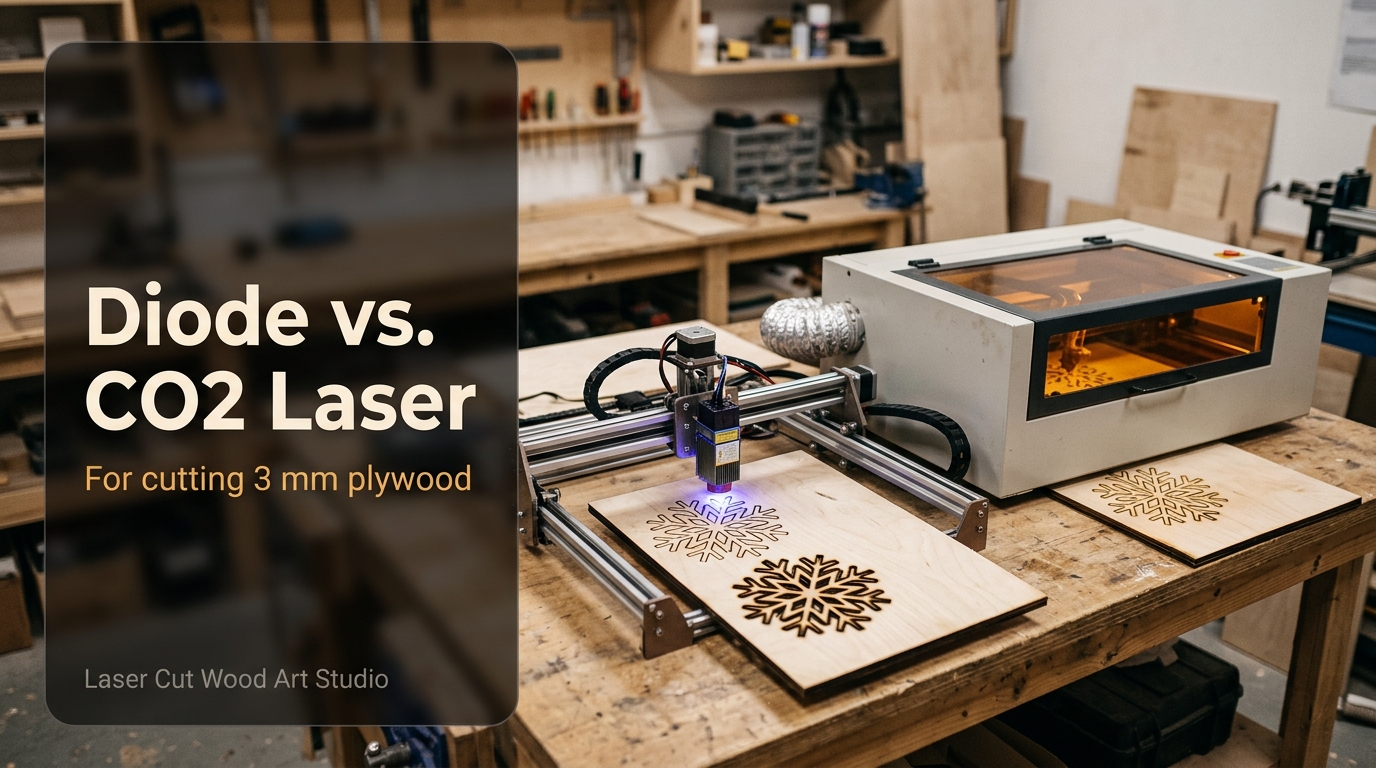
Walk into any woodworking maker forum, and you will find an endless debate between two rival camps. On one side, diode laser enthusiasts claim modern 20W and 40W blue semiconductor modules make bulky glass tubes obsolete. On the other side, traditional CNC operators insist that cutting plywood with anything less than a 50W CO2 laser tube is an exercise in charred edges, endless sanding, and wasted material.
If your primary business is cutting 3 mm (1/8-inch) Baltic birch for multilayer 3D wood art, intricate architectural screens, or interlocking boxes, choosing between these two optical platforms determines your daily profitability.
The difference between diode and CO2 lasers is not just about raw wattage or machine price tags. It comes down to fundamental optical physics: wavelength absorption, beam waist geometry, mirror gantry acceleration, and how timber adhesives react to thermal energy.
Here is a comparison of diode and CO2 lasers for processing 3 mm plywood, based on general laser physics and published manufacturer information. It explains what tends to cut cleanly, what tends to burn, and how to choose the right machine for your workshop.
The Physics of Wavelength: 455 nm Blue vs. 10,640 nm Infrared
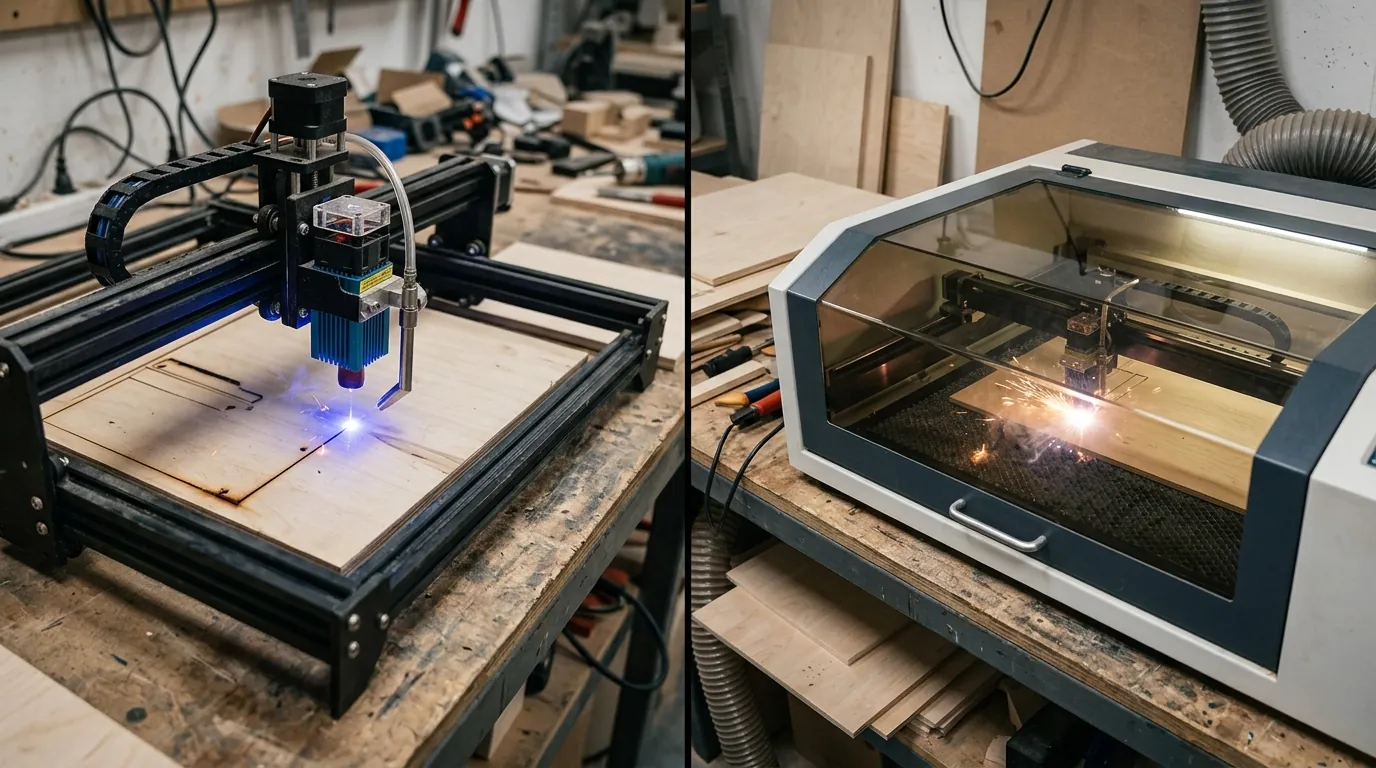
The single most critical difference between diode and CO2 lasers is the wavelength of light they emit:
- Diode Lasers: Emit visible blue light at approximately 455 nanometers (0.455 microns) using semiconductor Gallium Nitride (GaN) micro-chips.
- CO2 Lasers: Emit far-infrared radiation at 10,640 nanometers (10.6 microns) generated inside a gas-discharge glass tube filled with carbon dioxide, nitrogen, and helium.
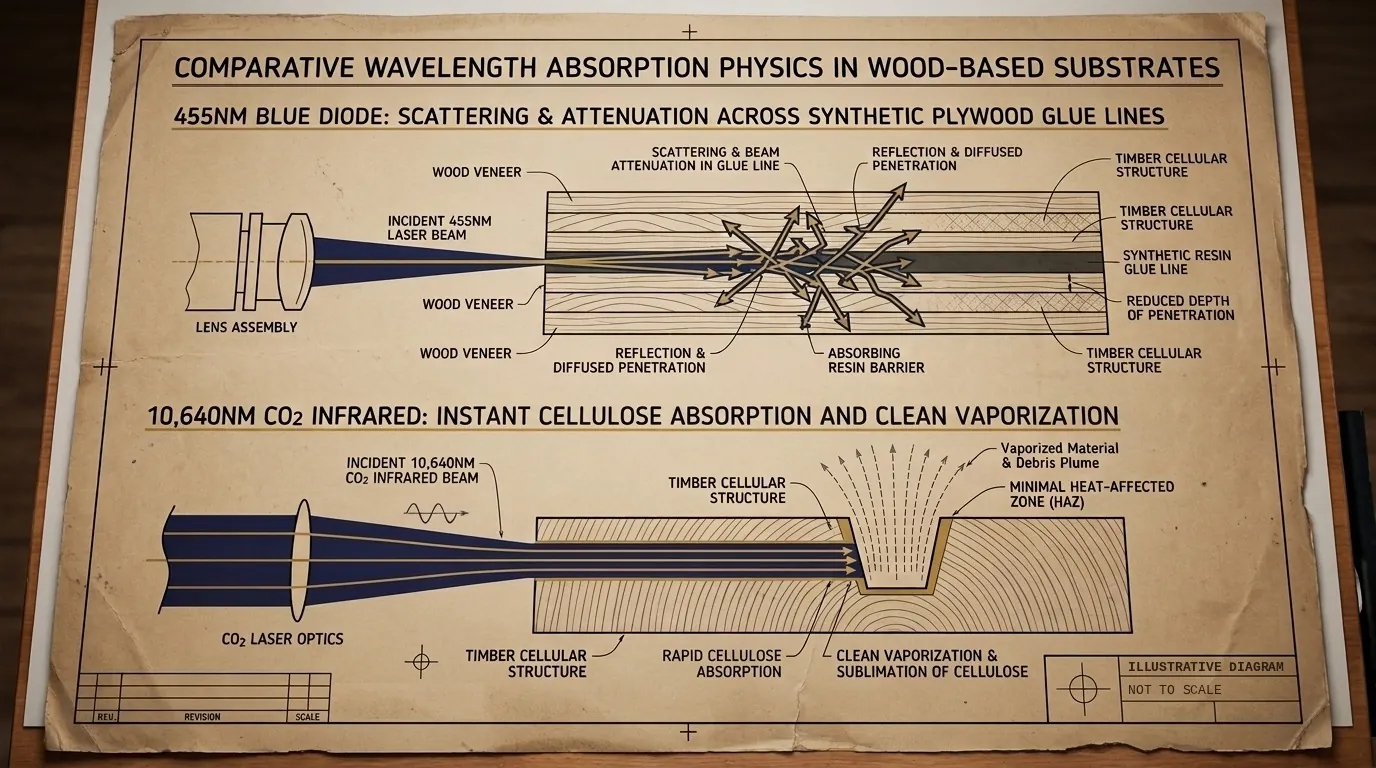
Why does wavelength matter for cutting wood? Organic timber fibers (cellulose, hemicellulose, and lignin) absorb 10,640 nm infrared radiation almost instantaneously. When a CO2 laser beam touches the surface veneer of Baltic birch, the organic wood matrix vaporizes into gas within fractions of a microsecond.
Visible blue 455 nm diode light interacts differently with wood. Blue light interacts with the synthetic glues inside plywood (such as phenolic resins or urea-formaldehyde) differently than with bare wood. Makers commonly report that diode lasers need more energy or extra passes to get through interior glue lines, which widens the heat-affected zone along the cut edge.
Cutting Speed and Edge Quality on 3mm Baltic Birch
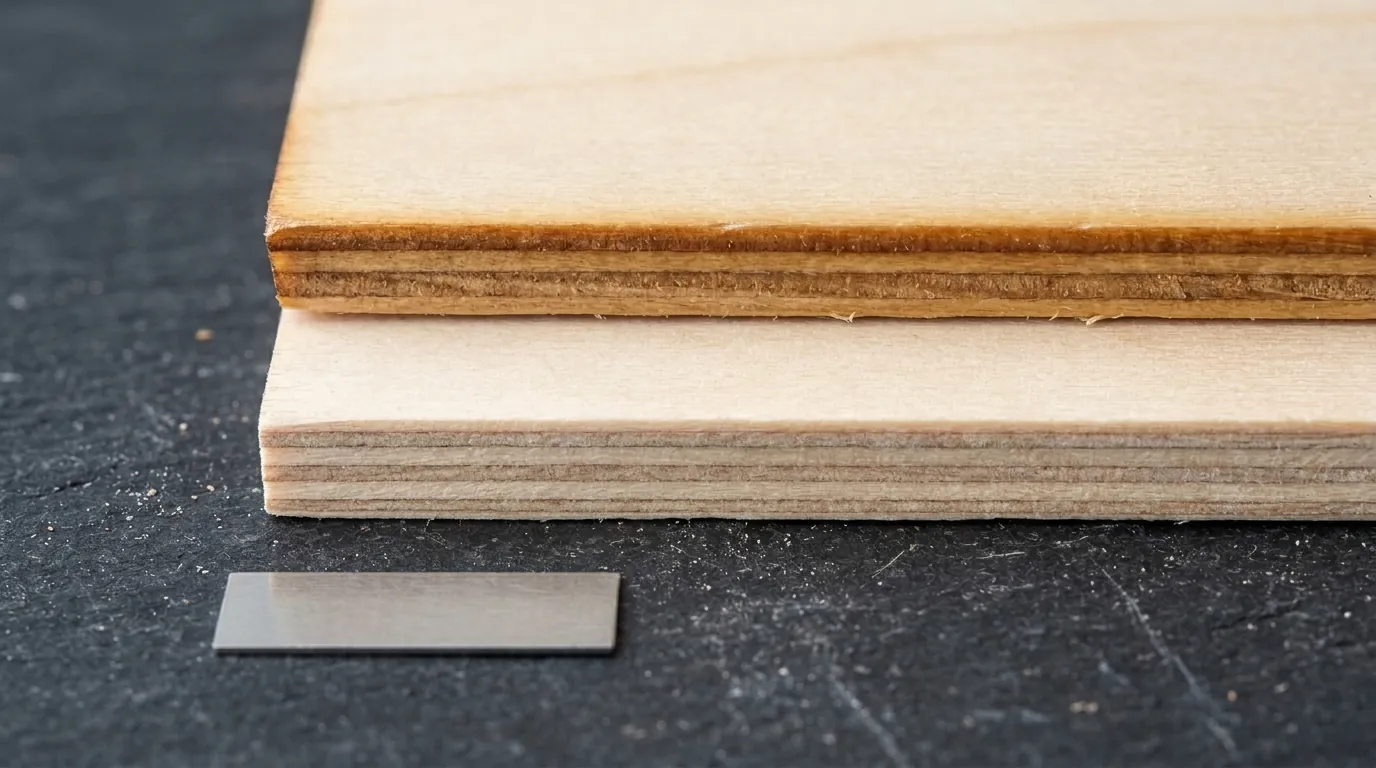
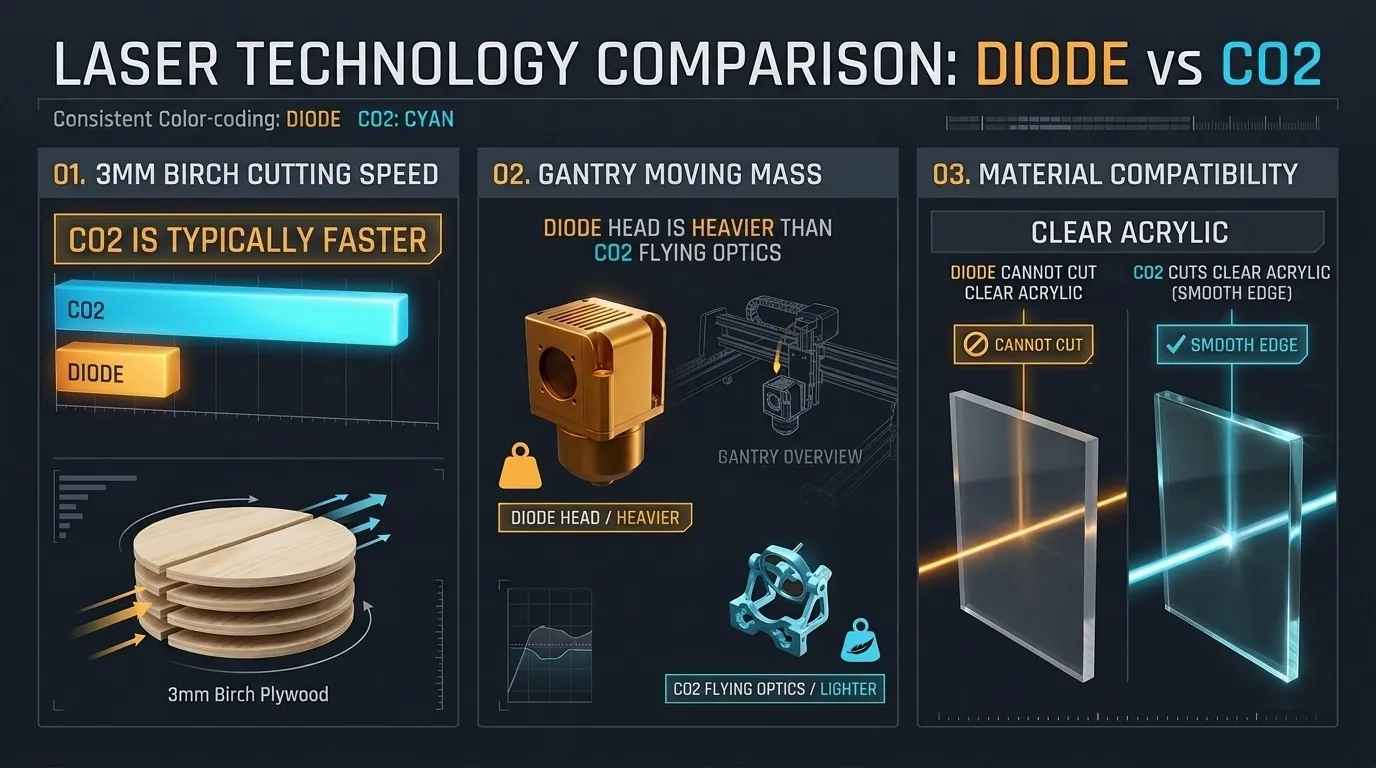
Published feed rates for 3 mm plywood vary widely between machines, wood species and focus settings, so this article does not give a single speed table. In general, a CO2 laser cuts the same job faster than a diode laser of modest power, and the gap grows as the material gets thicker. How large the gap is on your machine is something to measure with a scrap test.
| Laser type | Typical approach on 3 mm plywood | Edge tendencies | Where it fits |
|---|---|---|---|
| 10W-class diode | Slow single pass or two passes, air assist essential | Darker edge and a surface halo are common; masking tape helps | Hobby use, thin material |
| 20W-class diode | Single pass at moderate speed | Cleaner edge than 10W with good airflow; a slight taper is common | Small-batch craft work |
| Desktop CO2 (roughly 40 to 60W) | Single pass at higher speed | Straighter walls and a lighter caramel edge are typical | Regular production, acrylic |
| Larger CO2 (60 to 80W and up) | Single pass at higher speed, thicker stock | Similar edge quality, with more headroom for thick material | Batch production |
These are tendencies, not measurements. Test your own machine and your own plywood.
Motion Systems: Flying Optics vs. Moving Laser Heads
Speed is not determined by optical power alone. The mass that has to change direction also limits how quickly a machine can corner.
Diode lasers use a moving head design. The whole optical module, including heatsink, fan and driver electronics, rides on the X-axis gantry. During quick direction changes, such as cutting tight geometric fretwork, that momentum can cause belt oscillation, so slower cornering speeds are often needed to avoid rounded corners and wavy lines.
Most CO2 lasers use flying optics. The glass tube stays fixed at the rear of the chassis, and only a light carriage holding a mirror and a focusing lens moves along the gantry. Less moving mass generally allows faster acceleration through tight corners. Check each machine’s published acceleration and speed specifications.
Kerf Width and Detail Resolution
If your designs include very fine fretwork or tight finger joints, kerf matters. Values quoted online vary because kerf depends on focus, lens, air pressure and material, so measure it on your own machine and plywood.
- Diode lasers: The focused spot is often very small, which suits fine vector scoring and delicate details. On thicker stock, diode cuts often show a slight taper, with the kerf wider at the top than at the bottom.
- CO2 lasers: Kerf is generally somewhat wider than a small diode spot, but cut walls are typically straighter through the full depth of 3 mm plywood.
Material Versatility Beyond Wood
While 3 mm plywood is the core focus of decorative signage, workshops frequently expand into mixed-media products:
- Clear and Colored Cast Acrylic: A 50W CO2 laser cuts glass-clear acrylic with flame-polished, optical-grade transparent edges in a single pass. A blue diode laser cannot cut clear or translucent blue acrylic at all; the 455 nm blue light passes straight through transparent polymers without transferring thermal energy.
- Glass and Stone Marking: CO2 lasers micro-fracture glass surfaces cleanly, producing a frosted white etch. Diode lasers require dark tempera paint or thermal marking spray to engrave transparent glass.
- Dark Opaque Acrylic: Both diode and CO2 lasers process black, dark red, and opaque colored acrylics without issue.
Setup Footprint, Maintenance, and Operating Costs
Before purchasing, evaluate your workshop space and maintenance tolerance:
1. Diode Laser Realities
- Footprint: A compact desktop footprint that fits on a standard hobby workbench.
- Maintenance: Generally low. Keep the lens and protective window clean and check belts and screws. Manufacturers quote lifetimes in the thousands of hours, so check the maker’s rating for your module.
- Cooling: Air-cooled onboard heat sinks. No water chillers, tubing, or coolant additives required.
2. CO2 Laser Realities
- Footprint: Usually larger and much heavier than a diode laser, so plan a sturdy dedicated bench or stand.
- Maintenance: Requires mirror alignment. If the mirrors drift out of alignment, cutting power can drop in the far corners of the bed.
- Cooling: Glass tubes need active water cooling, and running a tube without it can damage it. Tubes have a limited lifespan measured in thousands of hours, and replacements cost money, so check the manufacturer’s rating and warranty.
Choosing a machine: When you compare machines, read the manufacturers’ specification pages together with independent reviews and owner reports, and confirm current prices and return policies before you buy.

Which Type Fits Your Production Goals?
To choose a laser for cutting 3 mm plywood, match the machine to your weekly volume and your materials:
A diode laser makes sense if:
- You are a hobbyist, craft fair seller or part-time maker producing a modest number of layered panels per week.
- Your workshop is an apartment, spare room or tight garage where space is limited.
- You want minimal alignment work and mechanical upkeep.
A CO2 laser makes sense if:
- You run a full-time production business with daily orders.
- Cutting time is directly tied to your revenue, and long panel cut times cost you money.
- You plan to cut clear acrylic, mark glass, or cut thicker hardwood sheets regularly.
Frequently Asked Questions (FAQ)
Can a diode laser cut clear acrylic like a CO2 laser?
No. Standard semiconductor diode lasers operate at a 455 nm blue wavelength, which passes directly through clear and translucent blue acrylic without absorbing heat. CO2 lasers emit at 10,640 nm in the far-infrared spectrum, which is strongly absorbed by acrylic, which can produce smooth, flame-polished edges.
Why does my 20W diode cut 3mm birch with a slight bevel?
Diode modules focus the beam to a small spot, and the beam widens above and below the focal point, so cuts often show a slight taper. CO2 lasers typically use longer focal-length lenses, which gives more depth of focus and straighter walls. Focus accuracy and air assist also affect the taper on your machine.
How long do CO2 laser tubes last compared to diode modules?
Both have limited lifetimes. Glass CO2 tubes need water cooling and are replaced when their output drops, and diode modules have no gas to leak. Manufacturers quote hours of use for each, so check the rating and warranty for the exact machine you are considering.