
Disclosure: This post contains affiliate links. If you make a purchase, we may earn a commission at no extra cost to you.
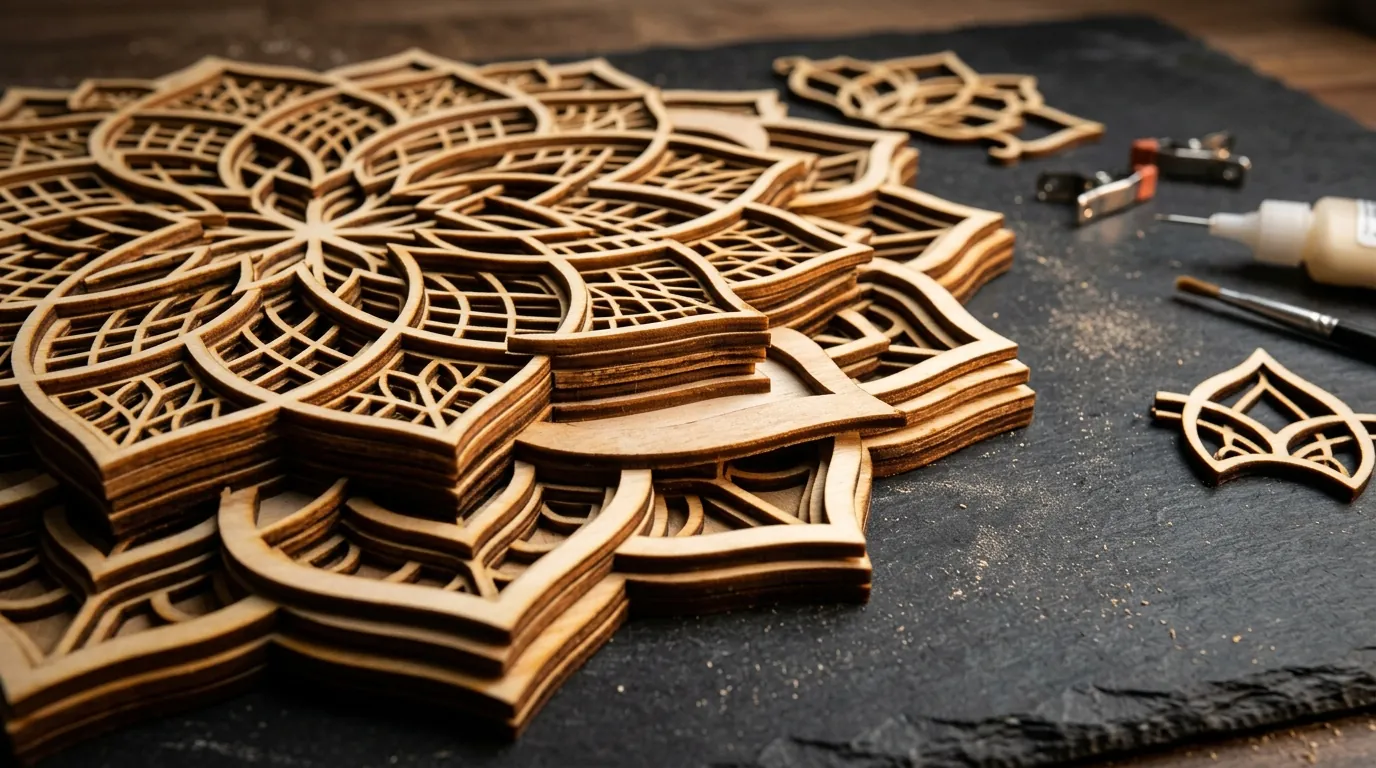
You spend four hours laser cutting an intricate eight-layer mandala wall piece, only to find the fifth layer warped like a potato chip, two internal corners charred black, and three delicate fretwork bridges snapped during assembly.
Nine times out of ten, the machine was not at fault. The problem lies inside the core of the sheet goods sitting on your honeycomb bed.
Multilayer 3D laser cut wall art places unique mechanical demands on wood. Unlike a simple flat coaster or a single-layer puzzle, stacked assemblies amplify every material defect. A 0.5 mm cup warp on layer two creates an unsightly 4 mm gap at the outer frame by layer eight. Inconsistent glue pockets stop a 20W diode beam dead in its tracks, while brittle face veneers tear out when you peel away protective transfer tape.
To build clean, heirloom-grade multilayer panels, you must match the right species, grading, thickness, and core adhesive to your specific laser setup. Here is a comparison of Baltic birch, basswood, and poplar plywood for precision laser craftsmanship.
Core Construction: The Real Culprit Behind Bad Cuts
Before evaluating wood species, you need to understand how veneer sheets are glued together. Plywood is not solid timber. It is an odd-numbered stack of rotary-cut wooden plies glued with alternating grain directions.
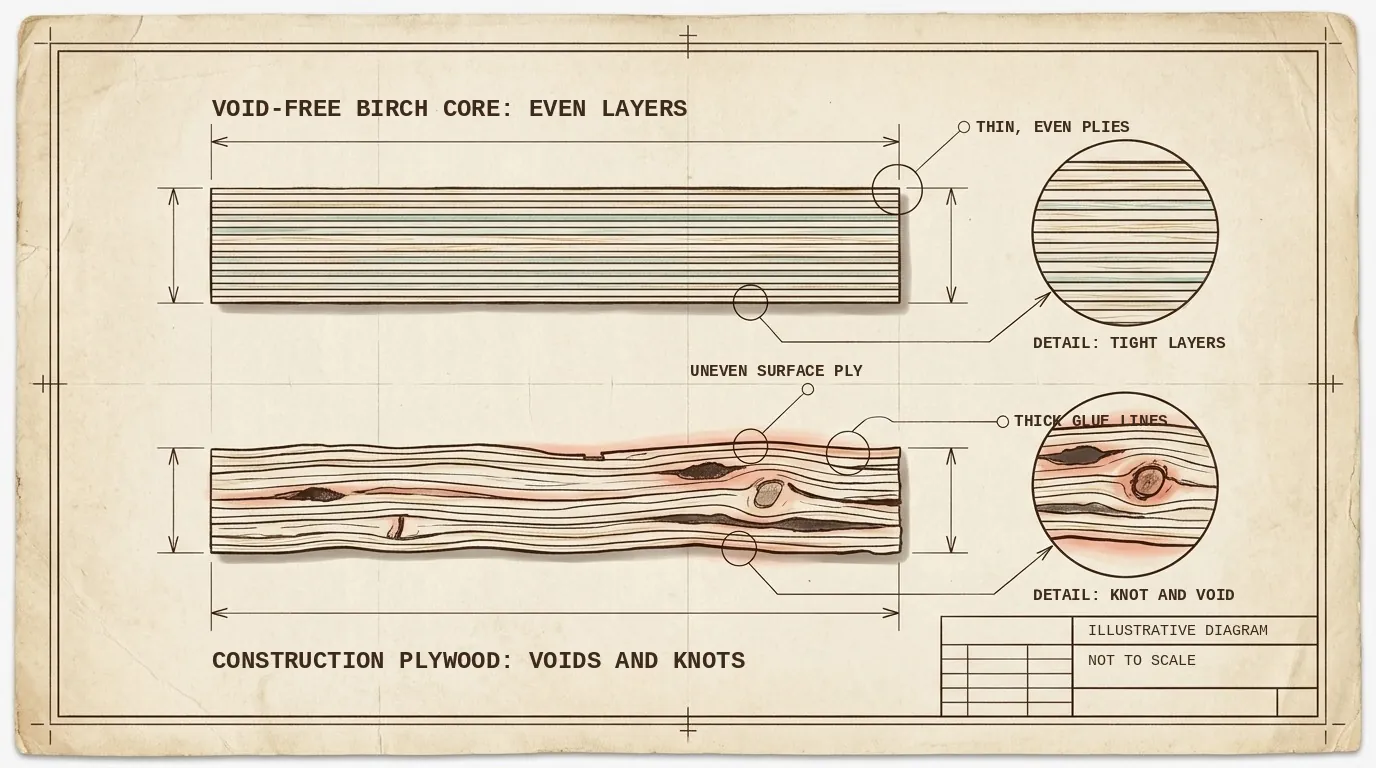
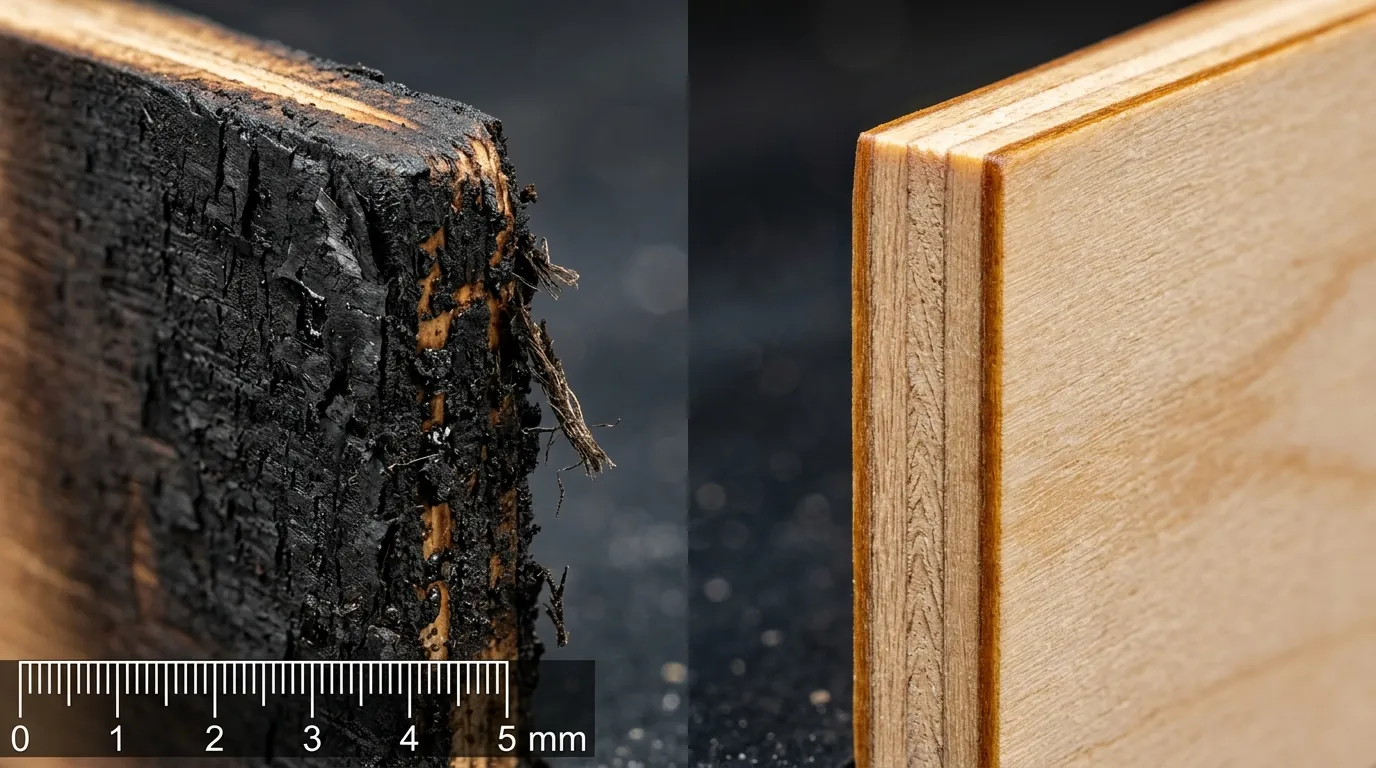
Construction-grade sheets from big-box home improvement stores contain interior voids, overlapping internal knots, and thick black exterior glue lines (phenolic resin / WBP). Phenolic glue absorbs 455 nm diode and 10640 nm CO2 laser radiation poorly. When a 10W or 20W beam hits an internal patch of exterior-grade adhesive, it stops penetrating. The top veneer burns, the bottom stays uncut, and you end up using an utility knife to butcher the back.
For 3D relief art, you need interior-grade interior adhesives (often urea-formaldehyde or modern soy-based glues) rated MR (Moisture Resistant). These glues cut cleanly under low optical power and leave clean, amber-tinted edges rather than sticky, soot-heavy ash.
Species Breakdown: Baltic Birch, Basswood, Poplar
| Wood Species | Typical density (kg/m3) | Laser Edge Quality | Stiffness / Rigidity | Best Layer Role |
|---|---|---|---|---|
| Baltic Birch (B/BB) | 680 – 700 | Usually a darker brown edge; air assist helps limit soot | Highest of the three | Structural base, structural frames, fine fretwork |
| Basswood Plywood | 410 – 430 | Usually a clean, light golden edge | Moderate; large thin pieces can flex | Top detail layers, micro-geometry, stained accents |
| Poplar Plywood | 450 – 480 | Light tan edge, usually little char | Moderate to high, highly flat | Backing boards, painted middle layers, large panels |
1. Baltic Birch: The Structural Gold Standard
Genuine Baltic birch (often graded B/BB or BB/BB) is made of birch veneers throughout its cross-section. A 3 mm (1/8-inch) sheet consists of three equal 1 mm plies, while a 6 mm (1/4-inch) sheet contains five plies.
Birch provides the highest density and mechanical stiffness of the three materials. Birch is stiff enough that thin filigree bridges are less likely to flex or snap during handling and staining, though very narrow bridges can still break. However, because birch is dense, it demands sustained optical power. Speeds that work for 3 mm birch vary a lot between machines, so run a speed and power test on scrap instead of copying a number. Weak air assist lets smoke deposit on the pale face veneer.
2. Basswood Plywood: The Intricate Detail Specialist
Basswood (American Linden) is a soft hardwood with an exceptionally fine, even grain texture and low resin content. Premium laser-grade basswood plywood typically features a soft basswood core wrapped in smooth micro-sanded face veneers.
Basswood cuts rapidly. It produces almost zero resin bleed, very low smoke residue, and silky, light-tan edges. If you operate an enclosed desktop diode laser (such as an xTool S1 10W or Atomstack A10), basswood allows you to cut intricate multi-layer mandalas at double the feed rate of Baltic birch. Its main limitation is low surface hardness: it dents under modest fingernail pressure and absorbs liquid stain unevenly without a pre-stain wood conditioner.
3. Poplar Plywood: The Budget & Large-Format Choice
Poplar (frequently Italian poplar) is widely used across European laser workshops. It offers a density of roughly 450 to 480 kg/m3 and distinct light-cream to greenish-grey undertones.
Poplar is exceptionally light and stays remarkably flat in storage. It cuts rapidly with minimal laser energy, leaving smooth edges with little charcoal dust. Because it is often cheaper than premium Baltic birch, it is a popular choice for large background backer layers (layers 1 through 3) where fine surface grain remains hidden from view. Be mindful that face veneers on commercial poplar plywood are paper-thin (often under 0.3 mm); sanding after cutting can expose darker interior glue lines.
Thickness Strategy: How to Build 3D Depth Without Weight
Beginners often make the mistake of cutting every single layer from the same 6 mm (1/4-inch) plywood. A 7-layer wall sculpture built this way ends up 42 mm deep, weighs over 8 kilograms, and risks pulling standard drywall anchors right out of the wall.
Adopt an engineered layering hierarchy:
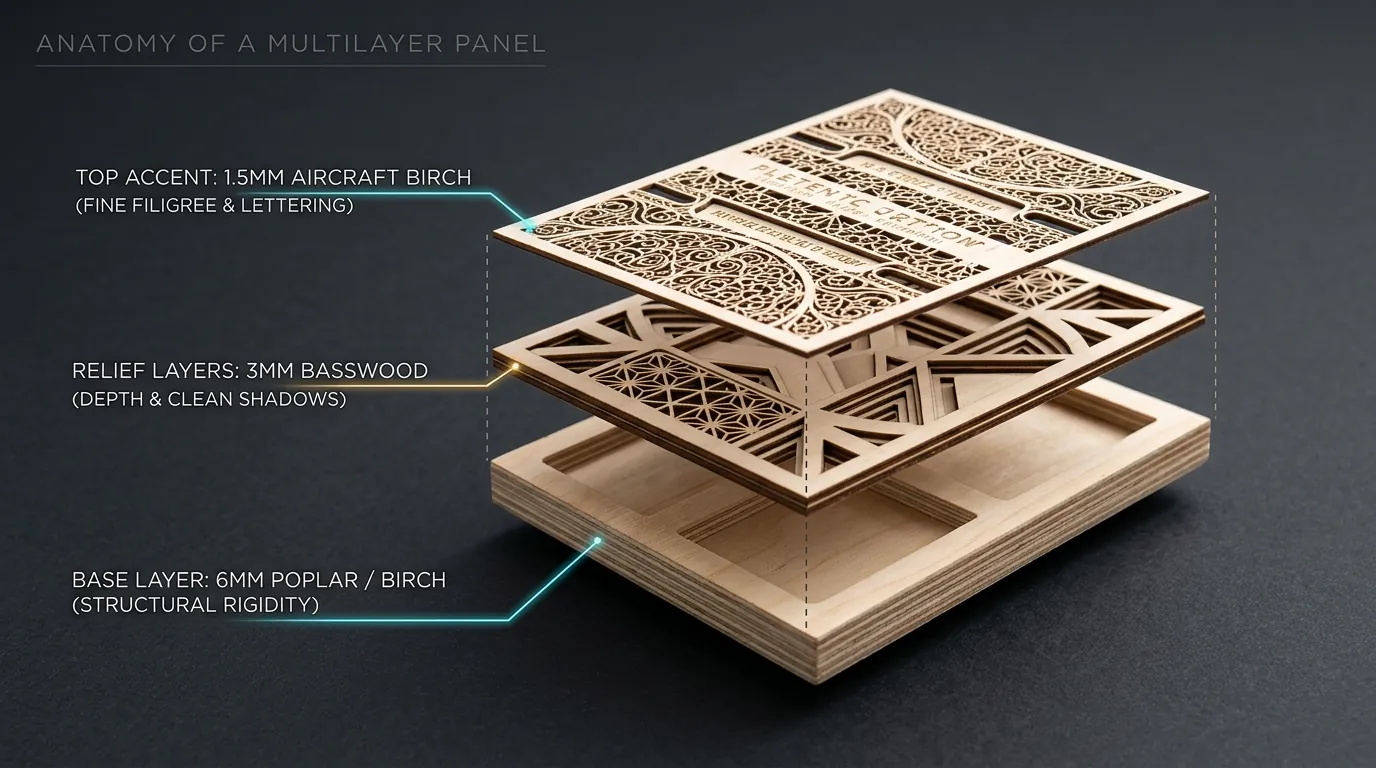
- Base / Backer Layer (Layer 1): Use 5 mm or 6 mm Baltic birch or poplar. This layer provides structural backbone, supports wall-hanging brackets, and prevents the finished artwork from warping as room humidity changes.
- Intermediate Relief Layers (Layers 2 to 5): Use 3 mm (1/8-inch) basswood or birch. This thickness delivers distinct shadows between levels without overloading the vertical profile.
- Top Filigree / Detail Layers (Layers 6 and 7): Use 1.5 mm to 2 mm 3-ply aircraft birch or micro-basswood. Ultra-thin stock enables razor-sharp corner geometry, tiny 0.8 mm vector cutouts, and delicate organic patterns that stay crisp.
Warp Prevention and Assembly Protocol
Wood moves. When you cut intricate patterns, internal stress inside the rotary-peeled veneer releases, making flat sheets curl. Here is how to keep multilayer panels flat and true:
- Pin your stock down: Do not rely on gravity alone on a honeycomb bed. Use plastic honeycomb bed pins (never metal screws near a laser head) to clamp the sheet flush against the steel honeycomb.
- Mask both faces: Apply paper application tape (transfer tape) to both the top and bottom of the sheet before cutting. This simple step greatly reduces smoke scorch marks, helps protect the timber from flashback reflections off the honeycomb ribs, and saves hours of tedious post-sand labor.
- Use low-moisture glue: Water-based PVA glues introduce liquid moisture back into the dried fibers, causing thin cutouts to buckle. Use thick, fast-grabbing gel PVA applied sparingly with a high-density foam roller, or spray a thin, even coat of high-tack aerosol contact adhesive. Clamp the entire assembly between two thick 18 mm MDF cauls lined with silicone parchment paper for at least three hours.
Workshop tip: air assist: Air assist moves smoke and resin out of the kerf and helps keep the lens clean. Use the airflow your machine’s manufacturer recommends, and test on scrap plywood before cutting a project.
Choosing Good Vector Cut Files
Even the highest-grade Baltic birch will disappoint if your digital cut geometry contains overlapping vectors, open nodes, or hair-thin segments thinner than the laser kerf (around 0.12 to 0.18 mm).
Always inspect downloaded vector files in wireframe mode before setting power and speed parameters. Look for clean, closed contours with continuous tool paths that minimize gantry deceleration.
Frequently Asked Questions (FAQ)
What is the difference between B/BB and standard Baltic birch?
B/BB is a surface grading designation. The ‘B’ face is clear, seamless, and free of patches or mineral streaks, making it ideal for the visible top layer. The ‘BB’ face may contain small oval egg patches where knots were milled out, making it suitable for rear backer boards or interior layers.
Can a 10W diode laser cut 6mm Baltic birch?
While a 10W diode can cut 6mm birch under multiple slow passes with strong air assist (for example, several passes at a slow speed), it risks significant edge charring and glue melting. For regular production work with 6mm sheets, a higher-power diode or a CO2 laser is generally the better fit; check independent cut tests for the exact machine.
Why did my multilayer panel warp days after being glued?
Post-assembly warping typically occurs when water-based wood glue introduces excessive moisture unevenly into one side of the thin plies, or when sheets are cut with differing moisture levels before conditioning to workshop humidity. Let your plywood acclimate in the workshop for a day or two before cutting, and use low-water gel adhesives.