
Disclosure: This post contains affiliate links. If you make a purchase, we may earn a commission at no extra cost to you.
You unbox your brand-new laser cutter, assemble the gantry, fire up your first test cut on a scrap piece of 3 mm plywood, and reality sets in within forty-five seconds.
Thick yellow smoke fills the room, triggering your household smoke alarms. The underside of your cut piece looks like a charred marshmallow, fused permanently to your waste spoilboard. To make matters worse, your laser nozzle leaves a fuzzy, brown soot stain across what was supposed to be a pristine Baltic birch surface.
The machine itself is rarely the problem. Manufacturers sell stock diode and desktop CO2 laser cutters in bare-bones configurations to keep the retail price low. The naked machine includes only the frame, the motion gantry, and the optical laser head.
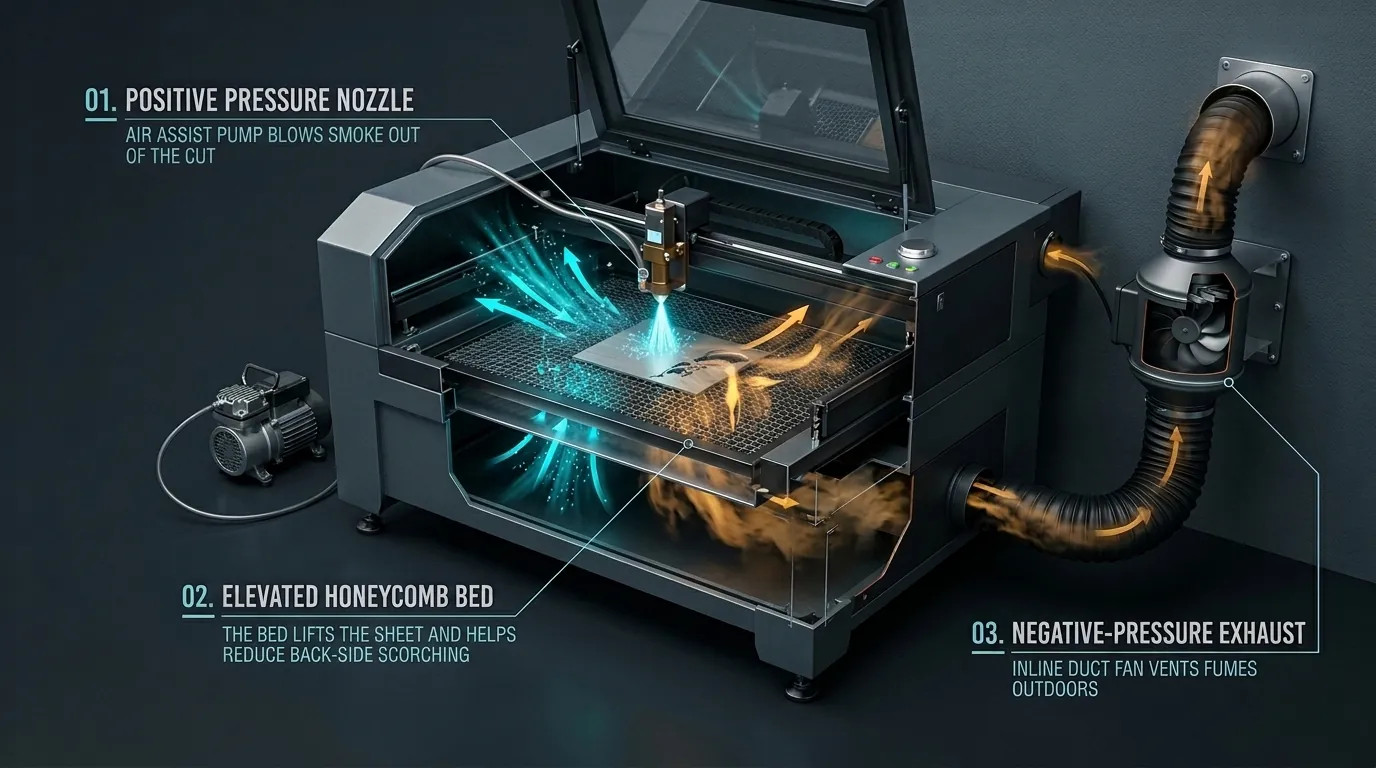
To transform an open desktop laser from a fire hazard into a precision manufacturing tool, you need three key peripheral upgrades: high-volume air assist, an elevated honeycomb cutting bed with steel backing, and dedicated negative-pressure fume extraction.
Here is the engineering breakdown of the three essential laser accessories every beginner should install before cutting their first production run.
1. Active Air Assist: The Difference Between Burning and Cutting
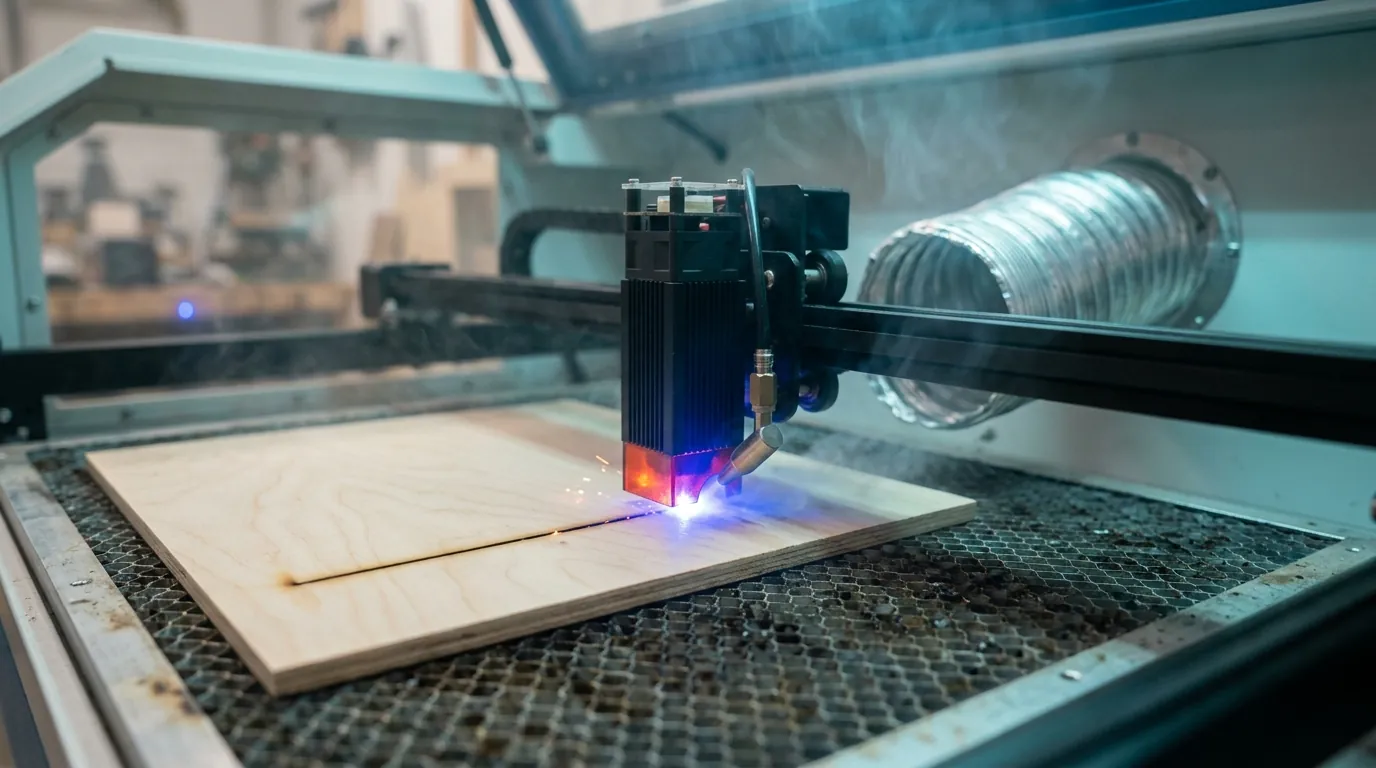
If you run a laser without air assist, you are not truly laser cutting; you are performing controlled combustion.
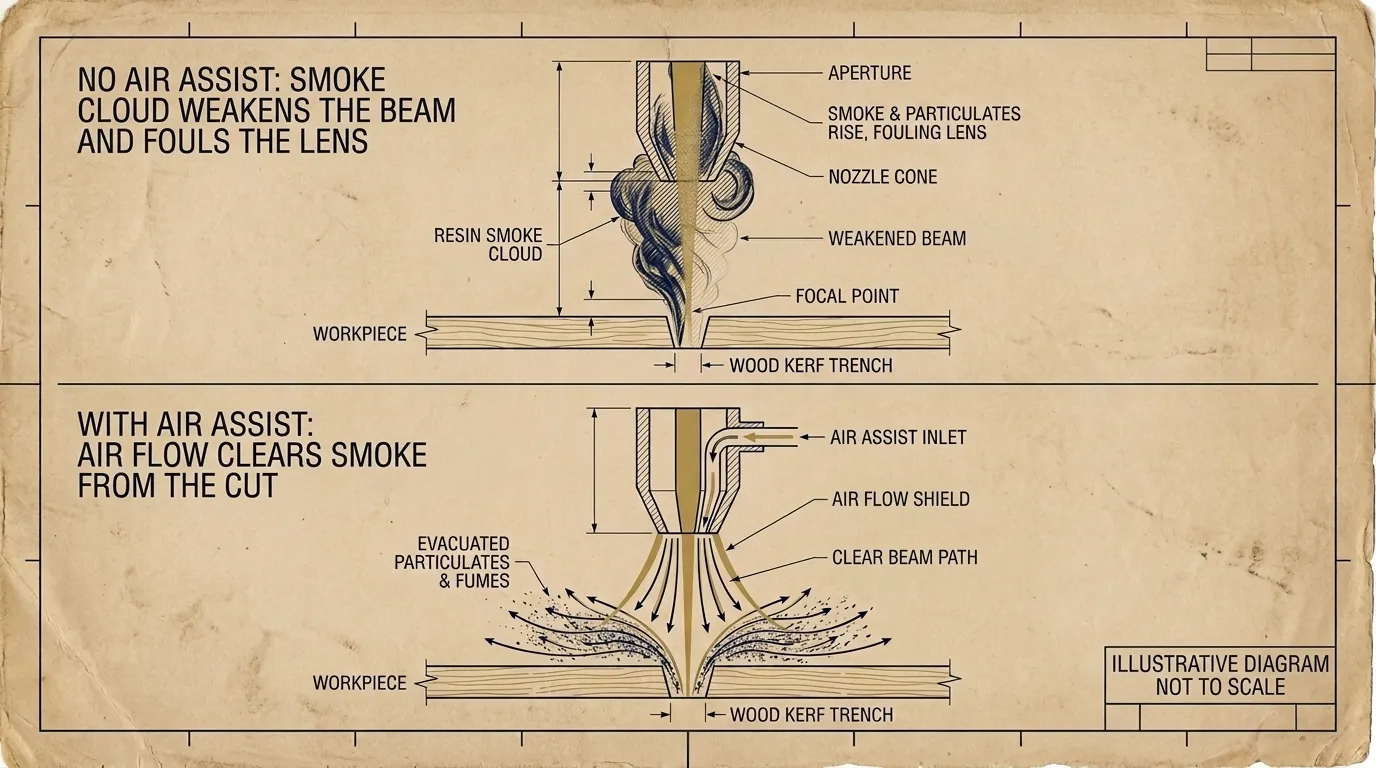
When a concentrated 455 nm diode or 10640 nm CO2 laser beam strikes wood, it instantly vaporizes the organic material into gaseous carbon, moisture, and sticky wood resins. Without an external air jet, this vapor cloud lingers inside the focal trench. The incoming laser beam must fight its way through its own smoke plume, which can weaken the beam before it reaches the uncut wood below.
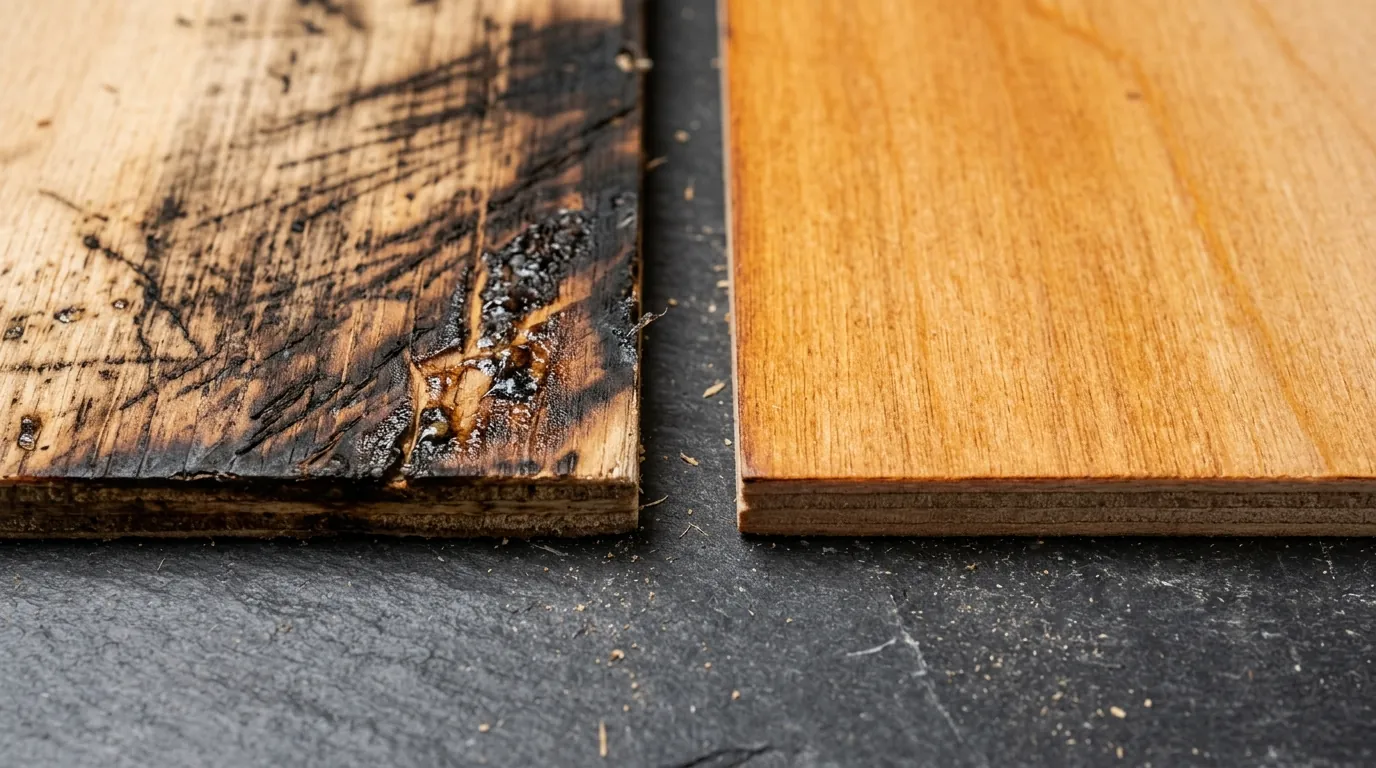
In addition, stagnant resin vapors ignite into micro-flames. These flames lick the top face veneer, creating wide charred halos and melting flammable tar directly onto your expensive optical focus lens.
What Air Assist Actually Does:
- Blows vaporized resin and carbon particulates out of the kerf trench instantly.
- Keeps oxygen starved at the cut point by displacing combustible gases with high-velocity air, preventing open flare-ups.
- Cools the adjacent timber edges, narrowing the burn zone and leaving an amber, paint-ready cut face.
- Pressurizes the inner cone of the laser nozzle, creating a positive air shield that stops smoke and airborne soot from coating the protective glass lens.
The Hardware You Need:
Do not rely on a tiny aquarium bubbler. Look for the air assist pump your laser’s manufacturer recommends, and compare its rated airflow and pressure with what the manufacturer specifies for cutting plywood. A pump that delivers steady pressure is what clears smoke out of a deep kerf.
2. Honeycomb Cutting Bed with Steel Shield: Defeating Flashback Char
Cutting wood directly on a flat aluminum sacrificial plate or a scrap wooden board ruins every project from below.
When the laser beam cuts through the bottom veneer of your plywood, the concentrated light beam hits the solid metal plate underneath. The metal reflects the optical energy upward at an angle directly into the rear face of your workpiece. Combined with trapped smoke, this phenomenon (known as flashback reflection) scorches heavy black grid lines and molten resin deposits across the entire back of your project.
Why a Honeycomb Bed Helps:
- Minimal Contact Surface: The narrow aluminum or steel honeycomb ribs support the sheet while leaving most of the cutting path suspended over open air.
- Downward Smoke Evacuation: Smoke is pulled cleanly downward through the hexagonal cells instead of flattening against the rear veneer.
- Magnetic Hold-Down: A honeycomb bed featuring a galvanized steel core allows you to use strong neodymium button magnets or 3D-printed plastic honeycomb pins to clamp warped plywood perfectly flat against the bed.
Pro Sizing Rule:
Always purchase a honeycomb bed that matches your machine’s full physical travel envelope (for example, 400 x 400 mm for standard diodes, or 500 x 700 mm for mid-size CO2 systems). Look for units with integrated aluminum border rulers and a removable 0.5 mm galvanized steel bottom shield to protect your workshop table from burn marks.
3. Negative-Pressure Fume Extraction: Workshop Air Safety
Vaporizing wood, glue, and acrylic generates dangerous airborne particulates. Plywood core adhesives release formaldehyde and volatile organic compounds (VOCs), while acrylic produces pungent methyl methacrylate fumes. Relying on an open window or a small 40 mm computer fan mounted on the laser head is dangerous to your respiratory health.
You must build a true negative-pressure extraction circuit consisting of an enclosure, an inline exhaust fan, and smooth-bore ducting.
| Component | Stock Entry-Level Solution | Professional Workshop Standard | Performance Impact |
|---|---|---|---|
| Air Assist Pump | None or 5 L/min bubbler | Dedicated air pump rated by the laser maker for cutting | Helps reduce edge char and can allow faster cuts |
| Cutting Support | Flat aluminum sheet or waste wood | Elevated steel honeycomb bed with table shield | Eliminates flashback burns, enables magnetic flattening |
| Exhaust Fan | Tiny 40mm gantry-mounted blower | Inline duct fan sized for your enclosure and duct run | Moves smoke outdoors; place and seal the duct to limit leaks |
| Ductwork | Flexible corrugated vinyl dryer hose | Semi-rigid aluminum or smooth-bore ducting | Less airflow resistance than ribbed flexible hose |
The Carbon Filter Reality Check:
If you cannot vent fumes out of a window and must use an indoor desktop air purifier, understand the consumable cost. A standard HEPA filter traps visible smoke dust, but does not stop toxic chemical odors. You need a purpose-built filter unit with a substantial activated carbon stage. Carbon saturates when cutting MDF or plywood and has to be replaced regularly, so check the manufacturer’s guidance.
Ventilation tip: Choose an inline duct fan rated for the airflow and static pressure your setup needs, vent outdoors, and follow the fan and laser manufacturers’ guidance.
Beginner Accessory Priority Matrix
If your workshop budget is limited, purchase your peripheral upgrades in this exact sequence:
- Phase 1 (Day One Safety): Enclosure and an inline exhaust fan vented outdoors. Never fire a laser indoors without active smoke removal.
- Phase 2 (Cut Cleanliness): A proper air assist pump and nozzle. This upgrade commonly speeds up cuts and reduces top-surface soot.
- Phase 3 (Backside Perfection): Elevated steel honeycomb bed and hold-down pins. Eliminates flashback burns and holds warped sheets flat.
- Phase 4 (Productivity): Stainless steel digital caliper for kerf measurement and silicone honeycomb cleaning wash trays.
These accessories add to your budget, so check current prices before you buy, but together they can turn an entry-level machine into a cleaner and safer workstation.
Frequently Asked Questions (FAQ)
Can I use an aquarium air pump for laser air assist?
No. Small aquarium pumps usually move too little air at too little pressure to clear resin smoke out of a deep cut. Look for a pump the laser manufacturer recommends for air assist and check its airflow and pressure ratings.
How do I clean sticky wood resin off my honeycomb bed?
Do not scrape the honeycomb ribs with metal tools; this bends the thin aluminum cells. Soak the bed in a shallow plastic tray filled with warm water and heavy-duty degreaser (such as Simple Green or Krud Kutter) for thirty minutes. The polymerized wood resin dissolves, and can be rinsed away with a standard garden hose.
Why does my workshop still smell like wood smoke with an exhaust fan running?
Smoke smell inside the shop usually indicates positive pressure leaks. This happens if your exhaust duct has leaky joints before the fan, if your duct run is too long with too many 90-degree elbows, or if your inline fan is positioned at the laser end of the hose rather than at the window exit point. Always place your inline fan as close to the outdoor exit as possible to keep the entire indoor duct under negative suction pressure.